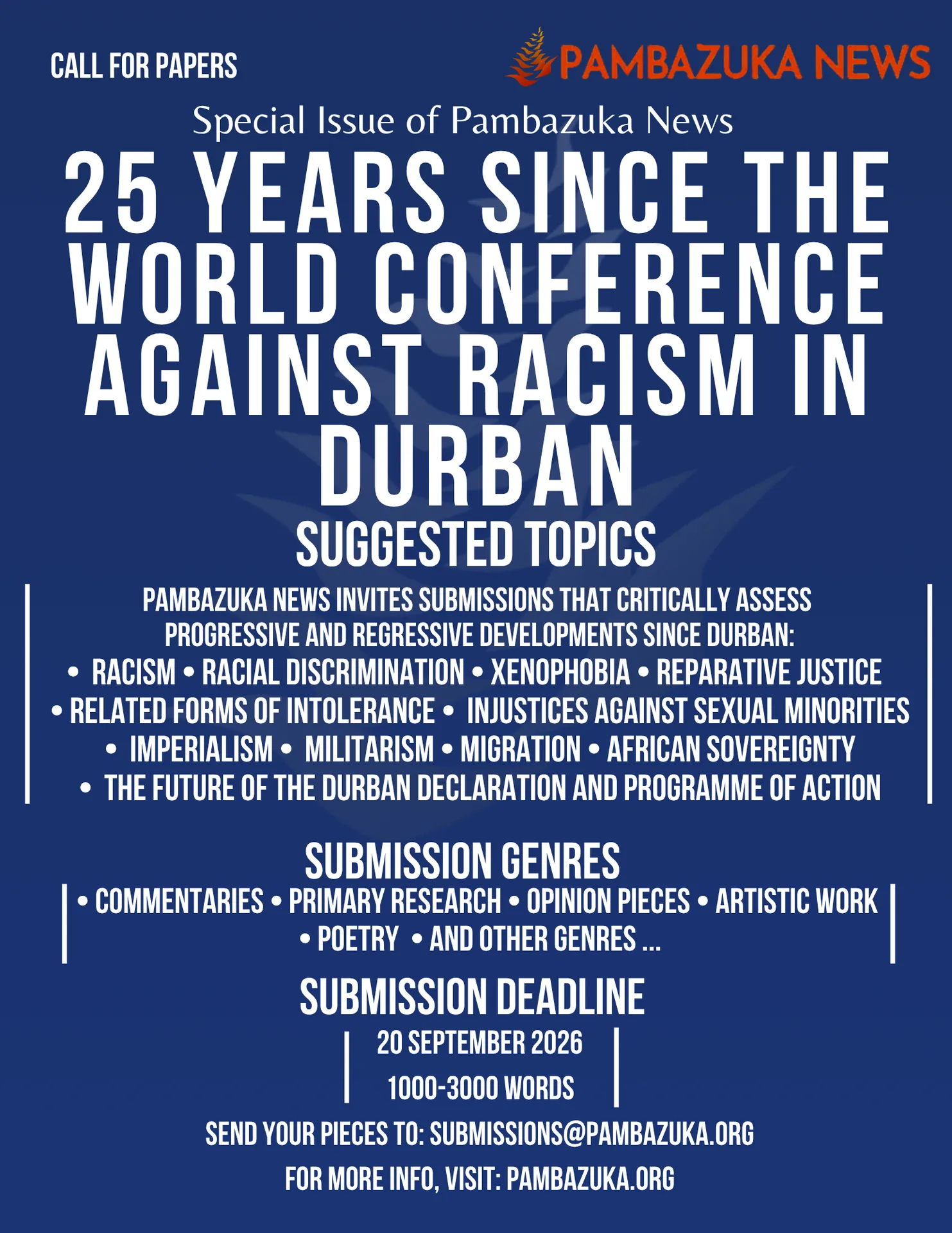
Call for Submissions: 25 Years Since the World Conference Against Racism in Durban
When, in 2026, the United Nations General Assembly declared the transatlantic slave trade and the racialized chattel enslavement of Africans the gravest crime against humanity, it marked the culmination of more than a century of political and diplomatic struggle and a high point in the effort to establish the centrality of the transatlantic slave trade in the history of humanity. This declaration emerged from generations of African resistance and a long international struggle to secure recognition of enslavement, colonialism, racial discrimination and their enduring consequences.
The defeat of apartheid in South Africa opened new political space for global organising. Forces advocating reparative justice lobbied the new South African government to host a World Conference Against Racism following the African National Congress's accession to power in 1994. South Africa subsequently hosted the 2001 World Conference Against Racism, Racial Discrimination, Xenophobia and Related Intolerance (WCAR) in Durban. Durban represented the convergence of decades of political struggle, diplomatic engagement and popular mobilisation around the historical and contemporary structures of racism. The Durban Declaration and Programme of Action (DDPA) provided an important international framework for confronting racism, racial discrimination, xenophobia and related intolerance and for addressing the enduring consequences of enslavement and colonialism. It expressly recognised that ‘slavery and the slave trade are a crime against humanity’ and connected these histories to continuing racism.
The anti-globalisation movements of the 1990s had registered major advances in struggles for peace, demilitarisation, women's rights, trade justice and youth rights. Mobilisations for reparations, peace and justice placed ruling forces on the defensive. The Durban process consolidated many of these struggles within a global framework. Yet, following the conference and the political climate created by September 2001, powerful forces sought to contain and depoliticise Durban's demands. The growing institutionalisation of Diversity, Equity and Inclusion (DEI) by dominant state and corporate institutions increasingly shifted attention from structural questions of imperialism, militarism and global power toward inclusion and representation. In this process, the transformative and anti-imperialist dimensions of Durban were diluted, while racism was increasingly treated as a question of institutional access rather than a system embedded in racial capitalism, war, extraction and global inequality.
The 25th anniversary of Durban comes amid profound geopolitical transformation across Global Africa and the world. The resurgence of neofascist and right-wing forces exposes the reversals in the struggle against racism, despite the worldwide mobilisation associated with Black Lives Matter. Racism and imperial power continue to structure the political, economic and social realities of the planet. Racial profiling is not simply a matter of individual prejudice but is embedded in policing, border regimes, immigration systems, security institutions and representations of African peoples. The criminalisation of African communities is reinforced by surveillance, selective crime statistics and media narratives that transform individual acts into evidence of collective African pathology. Afrophobia and anti Africanism have also intensified, including within African societies themselves. Xenophobic violence, anti-migrant campaigns and hostility toward other Africans must be understood within the political economy produced by colonial borders, brutal exploitation, genocidal economics and neoliberal restructuring. Imperialism has fragmented African societies while intensifying competition over employment, land, housing and public resources, enabling comprador forces to redirect grievances arising from economic dispossession toward migrants and other African communities.
Afrophobia weakens African solidarity, undermines continental integration and creates openings for external manipulation. Outside the continent, the resurgence of right-wing nationalism increasingly casts African migrants, refugees and people of African descent as scapegoats for economic and social crises. Tightened borders, deportations, detention, racialised surveillance and the militarisation of migration are presented as measures to defend national sovereignty and cultural identity, while obscuring the historical relationship between Western prosperity and the extraction of African labour and resources. The same imperial order that makes possible the movement of capital and commodities across borders increasingly seeks to restrict the movement of African people. The struggle against racism must therefore be situated within the broader struggle against imperialism, racial capitalism and the political fragmentation of African peoples. Building African independence, sovereignty and solidarity require confronting the structures that reproduce dependency, division and structural racism across the continent and throughout Global Africa.
Against this backdrop, Pambazuka News invites incisive commentaries, primary research, opinion pieces, artistic work, poetry and other genres that critically assess progressive and regressive developments since Durban. Submissions may address (but are not limited to) the future of the Durban Declaration and Programme of Action in the context of:
Racism, racial discrimination, xenophobia,
Intolerance, injustices against sexual minorities,
Environmental repair, reparative justice,
Institutions, imperialism, militarism,
Migration, African sovereignty
Anti-racist, anti-imperialist movements
Submission Deadline: 20 September 2026
Submit your 1000-3000-word article (including references) to submissions@pambazuka.org
Author guidelines available here: but feel free to email submissions@pambazuka.org for detailed guidelines.